




Deciding to study a trade is a smart move. Trades are hands-on, in demand, and they produce graduates who can actually get hired. But if you’re comparing your options and wondering whether painting, carpentry, or tiling is the right fit, you’re not alone. It’s one of the most common questions we hear from students at AABT College, and the honest answer is that all three are solid career paths. The right choice simply depends on what kind of work suits you.
Let’s break down each trade so you can make that decision with confidence.
Certificate III in Painting and Decorating (CPC30620)
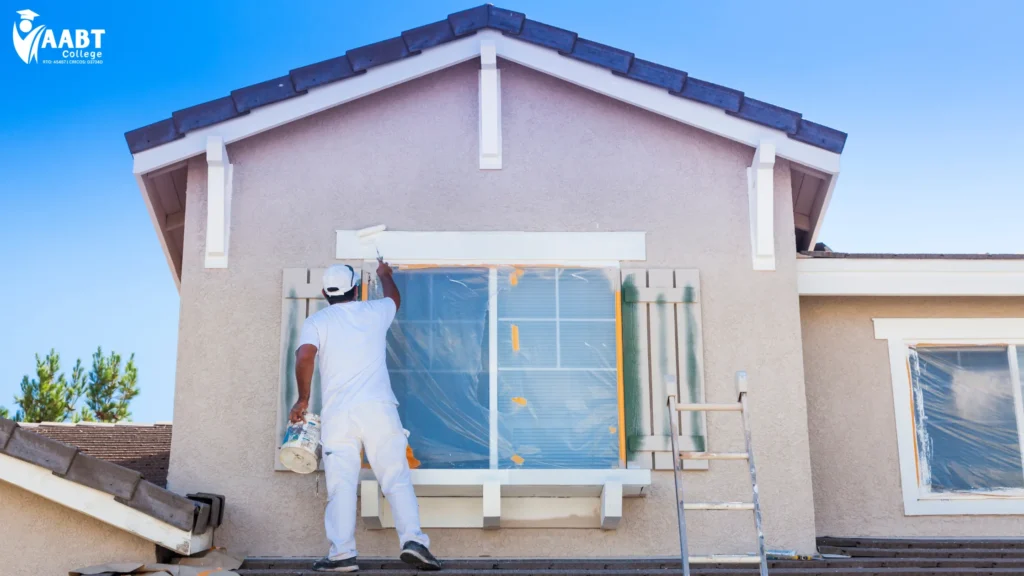
What you’ll learn: Painting is far more technical than most people expect. Over 52 weeks at AABT College, you’ll cover everything from surface preparation and brush-and-roller application to spray painting, decorative finishes, texture coatings, wallpaper, colour matching, and timber staining. Two units specifically cover safety around lead paint and asbestos – specialised knowledge that makes qualified painters genuinely more valuable to employers working on older Australian buildings.
The work: Painter’s work across residential homes, commercial fit outs, and large-scale construction projects. Many eventually work for themselves – painting is one of the trades with the highest rate of self-employment in Australia.
Physical demands: Moderate to high. Expect working at heights, using elevated work platforms, standing for extended periods, and handling spray equipment and power tools.
According to SEEK, painters in Australia earn an average of AUD $75,000-$85,000 per year in 2026, with over 1,300 painting jobs listed on the platform as of April 2026. Job growth for painting trades workers is projected at +2.9% over the next five years, according to Jobs and Skills Australia (ANZSCO 3322).
Certificate III in Carpentry (CPC30220)
What you’ll learn: Carpentry is the backbone of construction. At AABT College, the Certificate III in Carpentry is a trade qualification covering residential and commercial construction work – framing, formwork, fixing, flooring, roofing structures, doors, windows, and fit out. It’s a broad qualification that touches almost every stage of a building project.
The work: Carpenters are involved from the early stages of a build right through to the finishing details. Work ranges from large residential housing projects to commercial developments and renovations. It’s one of the most versatile trades because carpenters are needed at almost every point in the construction process.
Physical demands: High. Carpentry involves heavy lifting, working at heights, operating power tools and machinery, and being on your feet across full working days – often on active construction sites.
Salary in 2026: The average carpenter salary in Australia sits between $80,000 and $95,000 per year, with experienced carpenters and site supervisors earning above that range.
Best for: Students who want to be at the centre of the construction industry, enjoy structural and problem-solving work, and are comfortable with physically demanding, fast-paced environments.
Certificate III in Wall and Floor Tiling (CPC31320)
What you’ll learn: Tiling is a precision trade. The Certificate III at AABT College covers surface preparation, setting out tile layouts, cutting and fixing tiles on walls and floors, grouting, waterproofing, and working with a range of tile types across residential and commercial settings. Getting tiles level, aligned, and finished to a professional standard requires a strong eye for detail and careful, methodical work.
The work: Tilers work primarily on residential renovations, new builds, and commercial projects – bathrooms, kitchens, outdoor areas, and large commercial floors. It’s project-based work with clear, visible results at the end of every job.
Physical demands: Moderate. Tiling involves kneeling, bending, and working at ground level for extended periods, along with lifting materials and using cutting tools. It’s physically demanding but less intensive than carpentry in terms of heavy lifting.
Best for: Students who prefer careful, precise, detail-focused work and who want to see a finished, tangible result at the end of each project.
Side-by-Side Comparison
| AABT College | Painting | Carpentry | Tiling |
| AABT College Course Code | CPC30620 | CPC30220 | CPC31320 |
| Duration at AABT College | 52 weeks (45 weeks of class delivery and 7 weeks of break/holidays) | 62 weeks (50 weeks of class delivery and 12 weeks of break/holidays) | 62 weeks (50 weeks of class delivery and 12 weeks of break/holidays) |
| Physical Demand | Moderate-High | High | Moderate |
| Average Salary (2026) | $80K-$85K | $80K-$95K | $58K-$84K |
| Creative Element | High | Medium | Medium-High |
| Self-Employment Rate | Very High | High | High |
Which One Should You Choose?
If creativity, colour, and variety appeal to you, painting is your trade. If you want to be at the structural core of the construction industry and don’t mind intense physical work, carpentry is the most versatile path. If you’re patient, precise, and take satisfaction in a perfectly finished surface, tiling suits that mindset well.
The good news? AABT College offers all three-at the same Melbourne CBD campus, with practical classes at our dedicated North Melbourne workshop facility, and the same entry requirement of Australian Year 10 or equivalent across all courses.
You don’t have to guess which trade is for you. Talk to our admissions team, ask questions, and let us help you find the right fit.
Explore Building & Construction Courses | Apply Now




Leave a Reply